
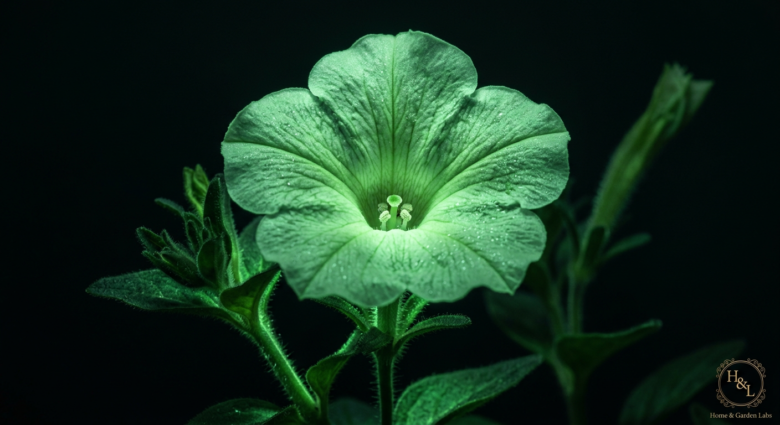
Imagine walking into your bedroom at night and being greeted by a soft, ethereal glow — not from a lamp, not from your phone screen, but from a living, breathing plant sitting quietly on your windowsill. No batteries. No electricity. Just pure, natural bioluminescence radiating from a flower that science has made possible.
That future is closer than you think. The glow in the dark petunia is real, it’s coming, and it’s about to revolutionize everything we thought we knew about houseplants, home décor, and the breathtaking possibilities of modern biotechnology.
Also Check Our Guide on Youtube.
What Is the Glow in the Dark Petunia?
The bioluminescent petunia is a genetically engineered living plant that produces its own natural light through a process rooted in biology rather than technology. Developed through cutting-edge plant biotechnology, this remarkable flower has been engineered by splicing bioluminescent DNA from Neonothopanus nambi, a glowing mushroom species native to Brazil, directly into the genetic makeup of a standard petunia plant.
The result? A fully living, soil-rooted, photosynthesizing houseplant that emits a soft, continuous green glow — 24 hours a day, 7 days a week — for as long as the plant is alive and healthy.
This isn’t science fiction. This isn’t a novelty product with hidden LEDs tucked into the soil. This is genuine, naturally occurring bioluminescence expressed through a flowering plant for the very first time in commercially available history. And it’s scheduled to arrive on the market in 2026.
How Does Plant Bioluminescence Actually Work?
To understand why the glowing petunia is such a groundbreaking scientific achievement, it helps to understand what bioluminescence actually is and why it has — until recently — remained confined to the animal and fungal kingdoms.
The Science Behind the Glow
Bioluminescence is the production and emission of light by a living organism. You’ve probably seen it in fireflies, deep-sea fish, or certain jellyfish. In fungi like Neonothopanus nambi, the glow comes from a biochemical cycle involving a molecule called luciferin, which reacts with oxygen in the presence of an enzyme called luciferase to produce light.
What makes mushroom bioluminescence uniquely suited for plant engineering is that this particular fungal light-producing system is self-sustaining. Unlike the bioluminescent pathways in bacteria or marine organisms — which require compounds that plants don’t naturally produce — the mushroom pathway runs on caffeic acid, a molecule that plants already manufacture as part of their normal metabolic cycle.
In simpler terms: the glowing mushroom’s light-making system runs on fuel that petunia plants already have in abundance. Scientists at Light Bio, the biotech startup behind the product, successfully integrated four genes from the bioluminescent mushroom into the petunia’s genome, essentially teaching the plant to glow using its own existing biological resources.
Why Petunias?
Petunias weren’t chosen by accident. They are among the most genetically well-understood flowering plants in the world, making them ideal candidates for genetic modification. They’re also hardy, adaptable to indoor environments, visually appealing, and already popular as both indoor and outdoor ornamental plants. Their existing familiarity with consumers made them the perfect vehicle for introducing bioluminescent plant technology to mainstream audiences.
The Company Behind the Glow: Light Bio
The bioluminescent petunia was developed by Light Bio, a biotechnology company based in Stanley, Idaho, with a mission to bring scientifically innovative, beautifully designed living products to everyday consumers. Their flagship product — the Firefly Petunia — received USDA regulatory clearance in 2023, a landmark moment that confirmed the plant poses no environmental risk and is safe for consumers.
Light Bio has taken a thoughtful, science-forward approach to bringing their product to market. Rather than rushing an untested novelty product to store shelves, they spent years refining the intensity of the glow, the health and longevity of the plant, and ensuring that the genetic modification has absolutely no adverse effects on the petunia’s natural growth patterns, flower production, or lifespan.
The Firefly Petunia — the trademarked name for their glow in the dark petunia — is expected to become available to consumers in 2026, with pre-registration interest already building significantly online.
What Does the Glow Actually Look Like?
This is probably the most common question people ask — and understandably so. The idea of a glowing plant sounds dramatic, almost theatrical. But the reality is more subtle and, arguably, more beautiful.
The glow emitted by the bioluminescent petunia is:
- Soft and green-hued, similar in tone to the gentle light of a firefly
- Continuous, meaning it glows throughout the day and night, though it’s most visible in low-light or dark conditions
- Concentrated in the flowers and young leaves, where metabolic activity — and therefore caffeic acid production — is highest
- Natural-looking, with an organic, living quality that no LED or artificial light source can replicate
Think of it less like a neon sign and more like moonlight caught inside a flower. It’s the kind of glow that invites you to lean in closer, to look more carefully, to feel a genuine sense of wonder.
Why Glow in the Dark Plants Matter Beyond the Wow Factor
It would be easy to dismiss the bioluminescent petunia as a novelty — a fun conversation piece or a quirky gift. And yes, it is absolutely those things. But the implications of this technology extend far beyond home décor.
A New Frontier in Plant Biotechnology
The successful integration of a self-sustaining bioluminescent system into a flowering plant opens extraordinary doors for the future of agricultural science, environmental monitoring, and plant biology research.
Imagine plants engineered to glow when they’re stressed by drought, disease, or nutrient deficiency — giving farmers real-time visual feedback about their crops without any sensors or technology. A bioluminescent trees lining city streets, reducing the need for electric street lighting. Imagine using glowing plants as living indicators of soil health or pollution levels.
The Firefly Petunia is, in many ways, proof of concept for all of these future applications. It demonstrates that complex, self-sustaining bioluminescent systems can be stably expressed in flowering plants — and that those plants can thrive.
Sustainable and Eco-Friendly Illumination Research
While a single petunia won’t replace your bedside lamp anytime soon, the long-term research trajectory pointed at by this technology has enormous sustainable lighting implications. Scientists are already theorizing about next-generation bioluminescent plants bright enough to serve as ambient lighting sources — living, carbon-absorbing, oxygen-producing alternatives to electric light.
How to Care for Your Bioluminescent Petunia
While full care instructions will come with the plant upon purchase, early information from Light Bio suggests that the Firefly Petunia requires care very similar to that of a standard petunia:
- Light: Bright, indirect sunlight for several hours per day — the more photosynthesis the plant performs, the more caffeic acid it produces, and the brighter it glows
- Watering: Regular watering with well-draining soil; petunias dislike waterlogged roots
- Temperature: Prefers moderate temperatures between 60–85°F; avoid frost
- Fertilization: A balanced fertilizer supports healthy growth and sustained luminescence
- Indoor vs. Outdoor: Suitable for both, though the glow is most visibly stunning indoors in dim lighting
One of the most exciting aspects of the bioluminescent petunia is that its glow is directly tied to its health — a thriving, well-cared-for plant glows more brightly. This creates an entirely new and deeply satisfying feedback loop between plant parent and plant.
Who Is the Glow in the Dark Petunia For?
The honest answer: almost everyone.
- Plant lovers and houseplant collectors looking for something genuinely extraordinary to add to their collection
- Science enthusiasts who want to own a living piece of biotechnology history
- Interior designers and home décor enthusiasts seeking an organic, conversation-starting centerpiece
- Gift-givers searching for something truly unique and unforgettable
- Parents and educators who want to introduce children to the wonders of biology and science in a hands-on, magical way
- Tech-forward early adopters who want to be among the first to own tomorrow’s innovations today
Frequently Asked Questions About the Glow in the Dark Petunia
Is the glow in the dark petunia safe for pets and children?
Based on current information and USDA clearance, the Firefly Petunia is considered safe. However, standard caution around any flowering plant applies, and Light Bio will provide detailed safety information with every purchase.
Will the plant glow forever?
>>The plant glows for as long as it is alive and healthy. Like any living organism, its lifespan depends on the quality of care it receives.
Can the glow be seen from across the room?
>>In a dark room, yes — the glow is visible at distance, though it’s most striking when viewed up close.
Is this plant GMO?
Yes, the Firefly Petunia is a genetically modified organism. It has received USDA regulatory clearance and is considered safe for home use.
The Bottom Line: A Plant That Changes Everything
The glow in the dark petunia isn’t just a houseplant. It’s a milestone. It’s the moment that bioluminescent plant technology stepped out of the laboratory and into our living rooms — beautiful, sustainable, and alive in the most extraordinary way.
Whether you’re drawn to it for its scientific significance, its interior design potential, its gift-giving uniqueness, or simply the childlike wonder it ignites every time you see a flower glow softly in the dark, the Firefly Petunia by Light Bio is something genuinely worth paying attention to.
2026 is coming. The future of plants is luminous.
Don’t Miss Out on the Glow
Ready to be among the first to own a living, glowing bioluminescent petunia?
Visit Light Bio’s official website to register your interest, stay updated on the 2026 launch, and be first in line when the Firefly Petunia becomes available. Share this article with a fellow plant lover, science enthusiast, or anyone who deserves a little more magic in their life — and drop your thoughts in the comments below.
Because some things are worth waiting for. And a plant that glows in the dark? That’s absolutely one of them.