Most people spend more time picking a new phone than they do studying a floor plan before buying a home worth hundreds of thousands of dollars. That gap is a problem. A floor plan is not just a drawing. It is the closest thing you have to a preview of your actual life inside that house. Every line, number, and symbol tells you something useful, and once you know what to look for, a floor plan can save you from a very expensive mistake. This guide breaks down how to read a floor plan for a house so you can look at one and actually know what you’re seeing. By the end, you will be able to spot red flags, compare layouts with confidence, and walk into any builder meeting or real estate showing with a clear head.
Who Gets the Most Out of This Guide
This is written for someone who is actively looking at homes or floor plans right now and has never been trained to read architectural drawings. Maybe a builder handed you a packet of floor plans for a new development. Maybe you found a listing online and clicked the floor plan tab, only to stare at lines and symbols that meant nothing to you.
You are not an architect. You are not a contractor. You are a regular person trying to make a smart decision about a home. That is exactly who this is for. If you have been in the industry for years, this will feel basic. But if you’re standing at the start of this process with a floor plan in your hand and no idea where to begin, keep reading.
What a Floor Plan Actually Is (And What It Is Not)
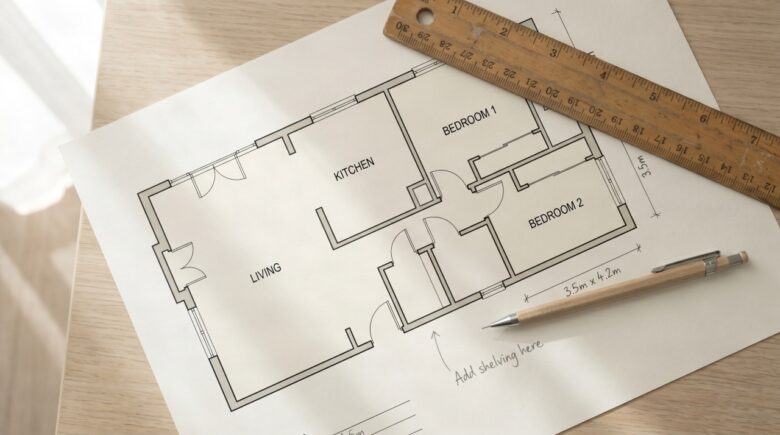
A floor plan is a scaled drawing that shows a bird’s-eye view of a home as if you sliced off the roof and looked straight down. It shows walls, doorways, windows, rooms, and sometimes furniture. The key word is scaled. That means every inch on paper represents a real measurement in the actual house.
Most residential floor plans use a scale of 1/4 inch equals 1 foot. So a room that measures 1 inch by 1.25 inches on paper is actually 4 feet by 5 feet in real life. That matters enormously because a room can look spacious on paper and feel like a closet when you are standing in it.
A floor plan does not show you everything. It does not show ceiling height, wall texture, window views, or natural light. It does not tell you what materials were used or how the space actually feels. Knowing what a floor plan leaves out is just as useful as knowing what it shows you. Use it as one tool, not the only one.
Architects and builders follow standard conventions when drawing floor plans, which means the symbols and line types you see are consistent across most drawings. Learning standard architectural drawing conventions can help you read any plan you encounter, not just the one in front of you today.
How to Read a Floor Plan for a House, Section by Section
Start With the Scale and Legend
Before you look at anything else, find the scale and the legend. The scale is usually printed in small text at the bottom of the page, often inside a title block. It will say something like “Scale: 1/4″ = 1′-0″”. The legend is a box that defines the symbols used throughout the drawing.
Do not skip this step. Reading a floor plan without checking the scale is like reading a map without checking the key. You might assume a bedroom is large because it looks large on paper, when in reality the scale reveals it is only 9 feet by 10 feet. That is a tight fit for two people sharing a room.
Pull out a simple ruler and actually measure the rooms that matter most to you. Multiply by the scale factor. Write down the real dimensions. This takes two minutes and saves enormous confusion later.
Read the Walls First
Walls show up on a floor plan as thick lines. Exterior walls are thicker than interior walls. Load-bearing walls are structural and cannot be removed without serious engineering work. Non-load-bearing walls can often be removed to open up a space, but you need a contractor to tell you which is which.
Look at how the walls flow from room to room. Notice where the walls create bottlenecks or awkward corners. A wall that cuts a hallway down to 36 inches might feel fine in a drawing but frustrating every single day. Wide openings between a kitchen and a living room, on the other hand, can make a modest square footage feel much larger.
If you are looking at an older home or a resale, the floor plan may not show all the walls accurately. Always compare the plan to what you actually see when you tour the home.
Understand the Door and Window Symbols
Doors appear on floor plans as a straight line with a quarter-circle arc. The arc shows which direction the door swings. This matters more than most people realize. A door that swings into a hallway can block traffic. A bathroom door that swings into the toilet is a daily annoyance.
Windows appear as a gap in the wall with a thin line or series of lines across it. Look at where the windows sit in each room. A bedroom with one small window on a north-facing wall will be dark in the morning. A living room with large south-facing windows will be bright but hot in summer. The floor plan gives you the position. You supply the logic about what that position means for your daily life.
Check every door swing in the kitchen especially. Appliance doors, cabinet doors, and the entry door all need room to open without hitting each other. This is one of the most common sources of frustration in kitchens that looked fine on paper.
Measure the Rooms That Matter Most to You
Square footage totals are marketing numbers. Room-by-room dimensions are the truth. A 2,000-square-foot home with a wide entry foyer and oversized hallways may have smaller actual living spaces than a 1,800-square-foot home that puts space where it counts.
The rooms that most affect daily life are the kitchen, primary bedroom, bathrooms, and living area. For bedrooms, a 10 x 12 room is workable for one person with a full bed. A 12 x 14 is comfortable for a queen. A master suite at 14 x 16 or larger gives you real breathing room. Average room dimension guidelines published by housing agencies can help you benchmark what you see against what is considered livable.
Write down the dimensions of every room you care about. Then grab a tape measure and lay those dimensions out in a room you already live in. That physical exercise tells you more than any floor plan ever could.
Look at Traffic Flow, Not Just Rooms
Traffic flow means the path people naturally walk through a home to get from one place to another. A good floor plan lets people move from the front door to the kitchen, from the bedrooms to the bathrooms, and from the garage to the kitchen without crossing through private spaces or cutting through other rooms.
Bad traffic flow creates friction every day. A home where you have to walk through the master bedroom to get to the second bathroom is a problem if you have guests. A kitchen placed far from the garage means carrying groceries a long way every week. These are not small complaints over time.
Trace the path you would walk each morning from your bedroom to the bathroom to the kitchen. Trace the path from the front door to the living room. Do the paths cross awkward zones? Does any path require you to walk through another person’s private space? The floor plan makes this exercise possible before you ever set foot in the home.
Check Bathroom Placement and Count
Bathrooms are expensive to add or move. What you see on the floor plan is almost certainly what you get. Count them first. Then look at where they are.
A full bath has a toilet, sink, and bathtub or shower. A half bath, also called a powder room, has only a toilet and sink. A three-quarter bath has a toilet, sink, and shower but no tub. These distinctions matter when you are planning for guests, kids, or resale value.
Bathroom placement matters too. A full bath directly accessible from the primary bedroom is a feature. A single bathroom shared by three bedrooms at the end of a long hallway is a logistical headache. Look at each bathroom on the plan and ask who is realistically going to use it most.
Read the Kitchen Layout as a Triangle
The kitchen work triangle is the path between the refrigerator, the stove, and the sink. A well-designed kitchen keeps these three points close enough to be efficient but spread out enough to allow two people to work without bumping into each other.
On the floor plan, look for these three elements and draw an imaginary triangle between them. If the total perimeter of that triangle is between 12 and 26 feet, it is generally considered efficient. A kitchen where the refrigerator is on one end of a galley and the stove is around a corner on the other side adds up to frustrating cooking every single night.
Also look at counter space. Counter runs appear as long, thin rectangles along the wall. A kitchen with very little counter shown on the plan will have very little counter in real life.
What Most Articles on This Topic Get Wrong
Most guides on how to read a floor plan stop at the symbols and measurements. They teach you what a door arc means or how to find the scale. That is useful but incomplete.
What they skip is the emotional layer of the plan. A floor plan is a diagram of how your daily life will actually function. The question is not just “can I read this plan?” The question is “does this plan match how my household actually lives?”
Here is a specific example. A family with two young kids and a dog will experience a home differently than a retired couple. The family needs a mudroom or at least a landing zone near the garage door. They need clear sightlines from the kitchen to where kids play. They need bathrooms that can handle morning rush hour. A floor plan that scores well on paper for the retired couple may be a daily struggle for the family. Always overlay your real routines onto what you see on the plan. Local building code requirements can also affect what a builder is allowed to change, so know those limits before asking for modifications.
How to Take Action Right Now
Get the floor plan in front of you. It can be a printout, a PDF on your phone, or a screen on your laptop. Find the scale first. Write it at the top of the page.
Next, measure the five rooms that matter most to your daily life. Use a ruler, multiply by the scale, and write the real dimensions next to each room on the plan. Then trace three paths through the home: morning routine, grocery run, and guest visit. Note anywhere the path feels awkward on paper.
After that, look at door swings in the kitchen and bathrooms. Flag any that create obvious conflicts. Write down your questions for the builder or agent. Bring that list to your next showing or meeting. Being specific gets you specific answers. Do not wait until you are standing in the actual home to start asking. The floor plan is available now, and that is where the work begins. If you are building new, also review our guide on questions to ask a builder before signing a contract so you go into that conversation prepared.
The One Thing to Remember
A floor plan is a tool for protecting yourself. It is not a formality to flip past before signing. The buyers who regret their home purchases most often say the same thing: the layout did not work for how they actually lived.
Learning how to read a floor plan for a house takes about an hour of focused practice. That hour can prevent years of daily frustration. Take the floor plan you have right now, sit down with a ruler and a pen, and work through it room by room. If you want to go deeper, bookmark this page and share it with anyone else involved in the buying decision. Two sets of eyes catch more than one.